
Public procurement in Canada: A buyer’s guide
Public procurement helps Canadian public-sector organizations turn public resources into essential services, infrastructure and stronger community outcomes. This practical guide explains the principles, processes and considerations that support fair, transparent and well-governed procurement—from early planning through contract management.
Learn how Canadian public-sector procurement works, which requirements buyers should consider and how connected digital workflows can support more transparent, consistent and well-governed processes.
What public procurement means for Canadian buyers
Public procurement in Canada is the process public-sector organizations use to plan, source, evaluate, acquire and manage the goods, services and construction they need to serve their communities. It includes much more than publishing a tender or selecting a supplier.
A strong procurement process begins by defining the business need and the outcome the organization wants to achieve. It continues through planning, market research, solicitation, evaluation and award, then extends into contract management, supplier performance and reporting.
Throughout the lifecycle, the goal is to create public value while protecting fairness, accountability and public trust.
The complete lifecycle
Procurement goes beyond sourcing
- Understand the need — Define the problem and desired outcome.
- Plan — Set the approach, roles and timeline.
- Source — Invite qualified suppliers to participate.
- Evaluate — Compare submissions fairly and consistently.
- Award — Document and communicate the decision.
- Manage — Track obligations, performance and risk.
- Measure — Use results to improve future procurement.
Why public procurement matters
Every procurement decision affects public services, the responsible use of public funds and the experience of participating suppliers.
Support effective public services
Acquire the goods, services and construction teams need to deliver programs, maintain infrastructure and respond to community priorities.
Use public funds responsibly
Consider overall value, including quality, service, lifecycle costs and risk—not simply the lowest initial price.
Encourage healthy competition
Create clear and accessible opportunities that give qualified suppliers a fair chance to participate.
Manage organizational risk
Use thoughtful planning, defined requirements, documented approvals and appropriate oversight to reduce financial, operational and reputational risk.
Maintain public confidence
Make procurement decisions that are transparent, consistent, well documented and able to withstand public scrutiny.
Strengthen supplier participation
Communicate clearly, remove unnecessary barriers and create a procurement experience that helps suppliers participate with confidence.
Federal guidance and jurisdiction-specific requirements
At the federal level, procurement guidance emphasizes sound stewardship, best value, risk-informed decisions, full lifecycle costs, effective governance, collaboration, and procurement that is fair, open and transparent.
Federal requirements do not automatically apply to every Canadian public-sector organization. Provincial, territorial, municipal and broader public-sector requirements vary by jurisdiction. Buyers should follow the legislation, trade agreements, policies, procedures and delegated authorities that apply to their organization.
Understanding Canada’s public procurement landscape
Canada’s public procurement landscape includes federal, provincial, territorial, municipal and broader public-sector organizations. Each operates within its own combination of legislation, policies, approvals and delegated authority.
Federal departments operate within federal legislation, policies, directives and delegated authorities. Provinces and territories maintain their own procurement frameworks, while municipalities and broader public-sector organizations may also have local policies, approval structures and sector-specific requirements.
Canada’s procurement structure
One landscape. Different requirements.
- Federal National policies and authorities.
- Provincial and territorial Jurisdiction-specific frameworks.
- Municipal and broader public sector Local and sector-specific requirements.
National framework
Federal procurement
Public Services and Procurement Canada, or PSPC, plays a central role in purchasing goods, services and construction on behalf of Government of Canada departments and agencies.
Federal departments and agencies also help define operational needs, confirm funding, develop requirements, participate in evaluations and monitor contract performance.
- Federal legislation and regulations
- Treasury Board procurement policies and directives
- Contracting and financial approval limits
- Delegated procurement authorities
- Departmental governance and oversight
- CanadaBuys and the federal Buyer’s Portal
Jurisdiction-specific frameworks
Provincial and territorial procurement
Each province and territory has its own procurement environment. Requirements may be established through legislation, policies, directives and internal government procedures.
Provinces and territories may also operate or designate their own procurement portals and services.
- Delegated purchasing authority
- Procurement and financial approvals
- Competitive procurement methods
- Trade-agreement obligations
- Accessibility requirements
- Records management and retention
Local and sector-specific requirements
Municipal and broader public-sector procurement
Broader public-sector organizations may need to follow provincial or territorial requirements alongside their own procurement bylaws, policies, procedures and delegated authorities.
Requirements can differ between organizations, even when they operate within the same province or sector.
- Municipalities
- School boards and educational institutions
- Hospitals and healthcare organizations
- Crown corporations
- Transit and utility organizations
- Other boards, agencies and public institutions
Practical guidance for buyers
Know which requirements apply
Requirements vary by jurisdiction, organization and procurement type. Buyers should confirm the legislation, trade agreements, policies and delegated authorities that apply to their organization.
Before choosing your procurement approach, confirm:
- Who holds the contracting authority
- Which organizational policies must be followed
- Where the opportunity must be published
- Which legislation and trade agreements apply
- What financial and procurement approvals are required
- Which accessibility, language, security and records obligations apply
Confirming the governing framework early helps your team choose the right process, reduce risk and build a clear, defensible procurement record.
Supporting better public procurement from planning through reporting
Strong public procurement depends on connected information, not isolated tasks. Planning, supplier communication, evaluations, contract oversight and reporting work better when each stage builds on the one before it.
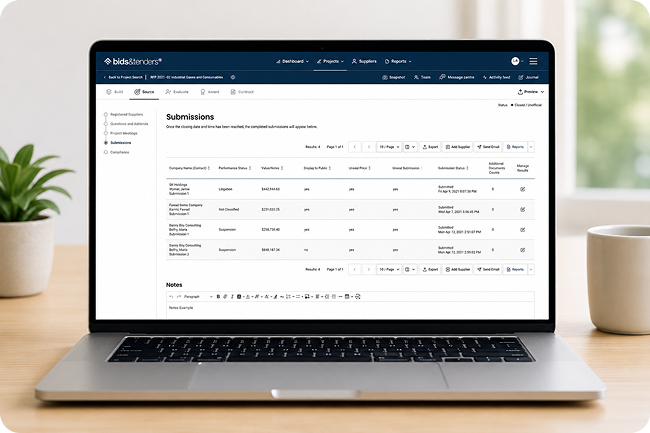
bids&tenders helps Canadian public-sector teams replace disconnected tools and manual handoffs with structured digital workflows. The result is a clearer, more consistent process that supports transparency, governance and better collaboration—without replacing professional judgement.
See how one connected platform can help your team simplify procurement while strengthening transparency, governance and collaboration.
Planning and intake
Plan and standardize procurement
The challenge
Procurement requests, documents and workflows can vary across departments, making it harder to plan work and apply consistent practices.
How bids&tenders helps
Structured intake, guided project workflows and reusable templates help teams involve procurement earlier and create a more consistent starting point for every project.
- Better planning. Greater visibility. Fewer manual handoffs.
Opportunities and submissions
Publish opportunities and support supplier participation
The challenge
Disconnected communications and difficult submission processes can create extra work for buyers and barriers for suppliers.
How bids&tenders helps
Centralized opportunity management, supplier communications and secure electronic submissions make opportunities easier to manage and participate in.
- Greater transparency. Less administration. A better supplier experience.
Evaluation and award
Evaluate and award with confidence
The challenge
Manual evaluations can be difficult to coordinate, especially when several evaluators, scoring methods and approval steps are involved.
How bids&tenders helps
Digital scorecards, weighted criteria, evaluator collaboration, conflict tracking and documented award workflows support more consistent evaluations.
- Stronger governance. Clearer records. Improved audit readiness.
Contracts and reporting
Manage contracts and procurement performance
The challenge
Contract records, milestones, supplier information and procurement data are often stored across separate systems.
How bids&tenders helps
Connected contract records, notifications, supplier performance tools and reporting help teams maintain visibility after award and use procurement information more effectively.
- More proactive oversight. Better-informed procurement decisions.
Supporting procurement teams across Canada






Secure, accessible procurement built for public accountability
Public procurement depends on confidence—confidence that sensitive information is protected, access is appropriately controlled and every decision can be clearly documented. bids&tenders supports Canadian buyers with role-based permissions, secure information management, detailed audit trails and accessible experiences for buyers, suppliers and evaluators.
The platform is designed to support recognized security and accessibility expectations, including SOC 2 Type II-aligned practices, ISO certifications, WCAG, ADA and AODA requirements. Structured workflows and complete procurement records also help teams follow organizational policies and support applicable trade agreement obligations, including CETA and CFTA.



See how bids&tenders helps Canadian procurement teams connect workflows, reduce administrative effort and strengthen transparency from planning through reporting.
Frequently asked questions
What is public procurement in Canada?
Public procurement is the process public-sector organizations use to plan, source, evaluate, acquire and manage goods, services and construction. It begins with understanding the business need and continues through solicitation, evaluation, award, contract management, supplier performance and reporting. Its purpose is to create public value while supporting fairness, accountability and responsible stewardship.
What principles guide Canadian public procurement?
Sound public procurement should be strategic, fair, transparent, competitive, well governed and focused on value. It should provide suppliers with consistent access to information, maintain clear and auditable records, manage risk and support responsible use of public funds. Federal procurement guidance similarly emphasizes best value, lifecycle costs, effective governance and processes that are fair, open and transparent.
Which trade agreements apply to public procurement in Canada?
The agreements that apply depend on factors such as the procuring entity, estimated value, type of requirement, exclusions, exceptions and set-asides. They may include the Canadian Free Trade Agreement, or CFTA, and international agreements such as CETA, the WTO Agreement on Government Procurement and the CPTPP. Buyers should verify current coverage and thresholds for each procurement rather than assuming the same agreements always apply.
What does best value mean in public procurement?
Best value is broader than selecting the lowest initial price. Depending on the procurement and governing requirements, buyers may also consider quality, service, lifecycle costs, supplier capability, risk, sustainability and the outcomes the organization needs to achieve. The evaluation approach should be established in advance and applied consistently using the published criteria.
How can digital procurement improve public procurement?
Digital procurement can help teams standardize workflows, centralize documents, manage supplier communications, receive submissions securely and maintain clearer audit trails. It can also make evaluations easier to coordinate, improve contract visibility and provide more useful procurement reporting. Technology is most effective when it supports professional judgement and makes good procurement practices easier to follow.
How does bids&tenders support public-sector buyers in Canada?
bids&tenders supports procurement from intake and planning through opportunity management, electronic submissions, evaluations, awards, contracts, supplier performance and reporting. Connected workflows help teams reduce administrative effort, improve consistency and strengthen transparency, governance and collaboration. The platform also supports secure information management, role-based access, audit trails and accessible experiences for buyers, suppliers and evaluators.