
Every public service depends on public procurement.
From road repairs and technology systems to healthcare supplies and community programs, public organizations rely on public procurement to acquire the goods, services, and construction they need.
In brief:
Public procurement is the structured process public organizations use to plan, source, evaluate, award, and manage purchases while protecting fairness, transparency, accountability, competition, and value for money.
Because public funds are involved, public procurement is more structured than private sector purchasing. This guide explains how public procurement works, why it matters, and how buyers can improve outcomes across the public procurement lifecycle.
What is public procurement?
Public procurement is the process public organizations use to acquire goods, services, and construction from external suppliers.
Public procurement covers much more than posting an opportunity. The process often begins by identifying a business need and planning the right approach. From there, buyers may research the market, develop specifications, select a procurement method, invite suppliers, manage questions, receive submissions, evaluate responses, approve an award, and manage the contract.
Public procurement also continues after award. Strong public procurement includes monitoring supplier performance, tracking contract outcomes, and using lessons learned to improve future procurements.
In other words, public procurement does not begin when an opportunity is published or end when a supplier is selected. It is a complete lifecycle that helps public organizations make informed, fair, and defensible decisions.
Why public procurement matters
Public procurement shapes how public organizations deliver services, maintain infrastructure, manage risk, and use public funds responsibly.
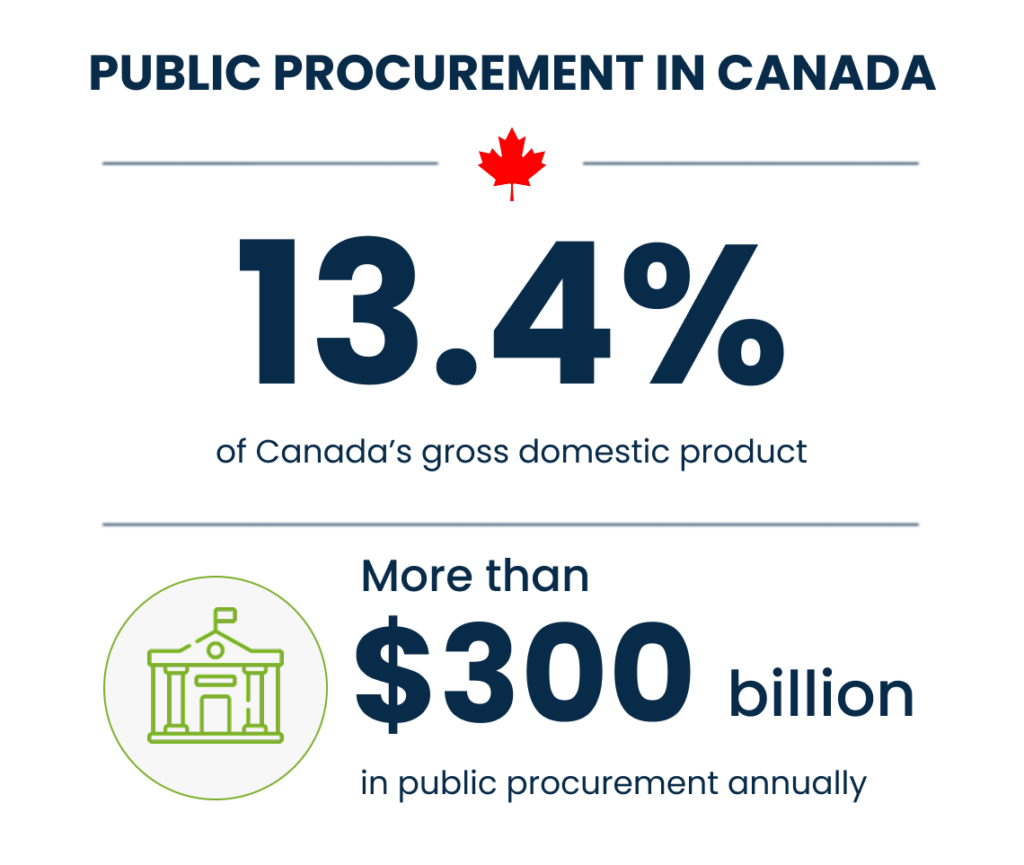
According to Public Services and Procurement Canada’s 2025 year-in-review report, public procurement represents approximately 13.4% of Canada’s GDP and more than $300 billion in annual spending.
According to the Canadian Collaborative Procurement Initiative’s 2025 year-in-review, public procurement represents approximately 13.4% of Canada’s GDP and more than $300 billion in annual spending – with the federal government accounting for roughly $37 billion of that total.
Good public procurement supports financial stewardship, encourages healthy supplier competition, improves service quality, and helps organizations achieve broader policy and community objectives. It also builds public confidence by making public procurement decisions more transparent, consistent, and accountable.
These decisions affect more than the procurement team. Public procurement influences residents, taxpayers, suppliers, internal departments, and the public institutions that depend on reliable goods and services.
For example, when a municipality procures a fleet-management system, it is not simply buying software. It is making a long-term decision that can affect operating costs, service reliability, data security, staffworkflows, and public accountability.
Public procurement is where organizational priorities, public funds, market capability, and service delivery meet.
How is public procurement different from private-sector purchasing?
Public and private organizations both need to buy goods and services, but public procurement is usually subject to more formal legal, policy, documentation, and oversight requirements than private-sector purchasing.
| Public procurement | Private-sector purchasing |
|---|---|
| Uses public funds | Uses company or investor funds |
| Must demonstrate fairness, transparency, and accountability | Focuses primarily on business value and organizational priorities |
| Often requires open competition | May negotiate directly with preferred suppliers |
| Follows legislation, trade agreements, and procurement policies | Usually follows internal purchasing policies |
| Uses formal evaluation criteria and approval processes | May use more flexible decision-making processes |
| Requires complete and defensible procurement records | Documentation requirements may be less formal |
| May be subject to audits, public scrutiny, or supplier challenges | Usually faces less public oversight |
| Must apply requirements and communications consistently | May adapt requirements or negotiations more freely |
Private-sector organizations can still have strong governance and competitive processes, but they often have more flexibility to move quickly, negotiate directly, or work with established suppliers.
A key difference is the level of public accountability. Public buyers must not only make a sound purchasing decision – they must also be able to explain and defend how that public procurement decision was made.
Who conducts public procurement?
Public procurement is carried out by a wide range of publicly funded organizations, including:
- Federal, provincial, and local governments
- Municipalities and regional authorities
- School boards and educational institutions
- Healthcare organizations
- Public utilities
- Transit agencies
- Housing authorities
- Emergency services
- Crown corporations and public agencies
Each organization may follow different legislation, trade agreements, procurement policies, and approval requirements. That’s why public procurement buyers must understand both general best practices and the rules that apply within their jurisdiction.
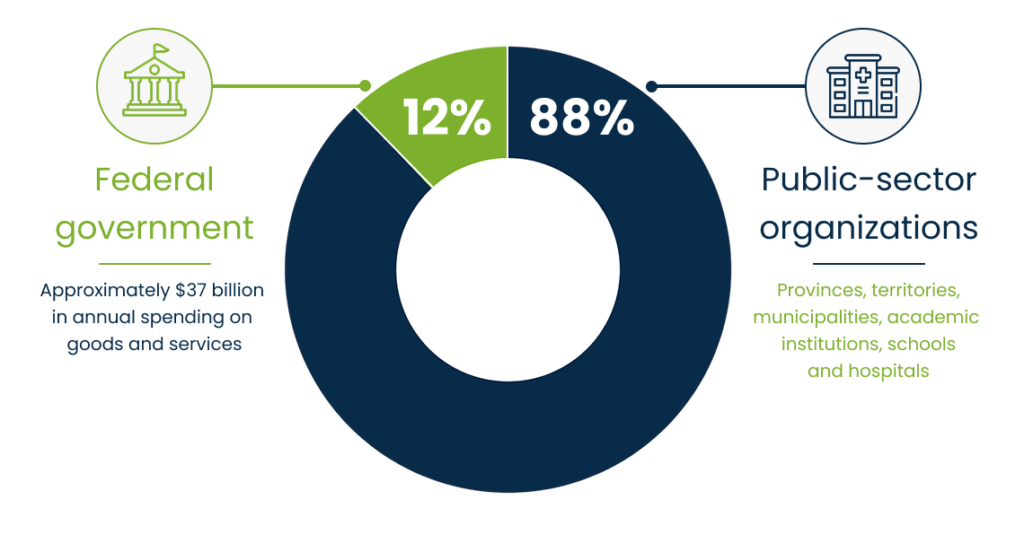
The MASH sector represents one of the largest and most active segments of Canadian public procurement, encompassing thousands of individual buying organizations that each run their own competitive processes.
Regardless of the organization, the goal of public procurement is the same: acquire what is needed in a fair, transparent, and responsible way.
What does the public sector procure?
Public organizations conduct public procurement for a wide range of goods, services, construction, and technology to support daily operations and deliver essential services.
Common examples include:
- Vehicles, equipment, office supplies, and safety materials
- Consulting, engineering, legal, maintenance, and training services
- Roads, public buildings, water systems, and facility improvements
- Software, cybersecurity, cloud services, and digital platforms
The scope of public procurement can range from routine purchases to complex, multi-year projects. In every case, the procurement approach should reflect the value, risk, complexity, and intended outcome of the purchase.
What are the core principles of public procurement?
Public procurement is guided by principles that help organizations protect public funds, support fair competition, and maintain trust.
Fairness
Suppliers should have a reasonable and consistent opportunity to compete. Buyers support fairness in public procurement by using clear requirements, sharing information equally, and evaluating submissions objectively.
Transparency
Public procurement decisions should be documented, understandable, and defensible. Clear evaluation criteria, consistent communication, and complete records help demonstrate how decisions were made.
Accountability
Roles, approvals, and decisions should be clearly assigned and recorded. This helps protect both the organization and the people involved in the public procurement process.
Competition
Open and accessible competition can improve value, encourage innovation, and strengthen supplier confidence in public procurement. Where non-competitive procurement is permitted, the rationale should be documented.
Value for money
The lowest price is not always the best value in public procurement. Buyers may also consider quality, lifecycle cost, service, risk, supplier capability, and long term outcomes.
Integrity
Public buyers must act impartially, manage conflicts of interest, protect confidential information, and avoid real or perceived preferential treatment.
Together, these principles help public organizations make procurement decisions that are responsible, consistent, and worthy of public trust.
How trade agreements and legislation shape public procurement
Public procurement in Canada operates within a layered framework of trade agreements and legislation that determine how – and sometimes whether – a purchase must be openly competed.
- The Canadian Free Trade Agreement (CFTA) sets internal trade rules between provinces and territories, including the dollar thresholds that trigger open competition requirements for goods, services, and construction.
- The Canada-European Union Comprehensive Economic and Trade Agreement (CETA) opens qualifying federal and sub-federal public procurement to EU suppliers above specified thresholds, and vice versa.
- The WTO Agreement on Government Procurement (WTO-AGP) extends similar obligations to suppliers from other member countries for procurements above set values.
These agreements typically set minimum dollar thresholds by procurement category – goods, services, and construction each have their own limits. Purchases below a threshold may allow more flexibility in method selection, while purchases above it usually require open, published competition. Understanding which agreements and thresholds apply is a foundational step in selecting the right public procurement method, and getting it wrong can expose an organization to supplier complaints or legal challenge.
The public procurement lifecycle
The public procurement lifecycle is a complete process that begins before a solicitation is published and continues after a contract is awarded.
1. Identify the need
Define the problem, desired outcome, budget, stakeholders, and risks before deciding what to buy.
2. Plan the procurement
Set the strategy, timeline, approvals, evaluation approach, and contract requirements. Early planning helps reduce delays and avoid rushed decisions.
3. Research the market
Understand supplier capability, market conditions, pricing, and potential barriers to competition.
4. Develop the requirements
Create clear, measurable, and objective specifications that describe what the organization needs without unnecessarily restricting suppliers.
5. Select the procurement method
Choose an approach that reflects the purchase’s value, complexity, risk, and applicable trade agreement or legislative requirements.
6. Invite suppliers
Publish the opportunity or invite qualified suppliers, then manage questions, clarifications, and addenda consistently.
7. Receive and evaluate submissions
Protect submission confidentiality and evaluate proposals using the criteria disclosed in the procurement documents.
8. Approve and award
Document the recommendation, obtain required approvals, notify suppliers, and finalize the contract.
9. Manage the contract
Monitor deliverables, performance, risks, changes, renewals, and supplier obligations throughout the contract term.
10. Review the results
Measure whether the public procurement achieved its intended outcome and apply lessons learned to future projects.
Managing each stage of the public procurement lifecycle well helps organizations improve transparency, reduce risk, strengthen competition, and achieve better long-term value.
Common public procurement methods
Public organizations use different public procurement methods depending on the value, complexity, risk, and nature of the requirement.
Request for quotation
Often used for straightforward public procurement where requirements are clear and suppliers can provide comparable pricing.
Competitive solicitation
Used when requirements are sufficiently defined and suppliers can be evaluated against disclosed criteria. Depending on the jurisdiction, this may be called an invitation to tender, request for tender, invitation for bids, or another formal solicitation type.
Request for proposal
Used when the organization wants suppliers to propose an approach and the evaluation considers factors beyond price, such as experience, methodology, service, and overall value.
Request for qualifications
Used to assess supplier capability before inviting selected suppliers to submit a detailed proposal.
Standing offer or framework arrangement
Used for recurring public procurement needs when exact quantities or timing may not be known in advance.
Invitational procurement
A limited number of suppliers are invited to compete where policy permits.
Non-competitive procurement
May be allowed in specific circumstances,such as emergencies, exclusive rights, or the absence of reasonable competition.
The right public procurement method should support the business need while protecting fairness, transparency, competition, and compliance with applicable rules.
What responsibilities do public procurement buyers have?
Public procurement buyers are responsible for more than managing documents and timelines. Their decisions help protect public funds, support fair competition, maintain supplier confidence, and preserve public trust.
Key public procurement responsibilities include:
- Planning early and involving the right stakeholders
- Developing clear, objective, and non-restrictive requirements
- Selecting an appropriate procurement strategy
- Managing supplier communications consistently
- Protecting confidential information
- Documenting decisions and approvals
- Following delegated authority and organizational policy
- Identifying and managing conflicts of interest
- Monitoring contract performance after award
- Maintaining complete procurement records
These responsibilities also affect service continuity, organizational reputation, and long term contract outcomes.
Public procurement professionals do not simply process purchases. They help organizations make defensible decisions and achieve better outcomes with public resources.
How supplier complaints and oversight work in public procurement
Because public procurement decisions must be defensible, most jurisdictions maintain formal channels for suppliers to raise concerns or challenge a process.
At the federal level, the Office of the Procurement Ombudsman reviews supplier complaints and federal procurement practices, and offers alternative dispute resolution between suppliers and government organizations. Many provinces and larger municipalities maintain similar review or appeal mechanisms, and some procurement disputes may proceed to formal legal or tribunal review.
These oversight mechanisms reinforce why documentation matters throughout the public procurement lifecycle – a well-documented, consistently applied process is easier to defend if a decision is ever questioned.
Common public procurement challenges
Public procurement can become difficult when planning, requirements, communication, or oversight are inconsistent. Many common challenges can be reduced with a more structured approach.
Unclear requirements
This often happens when stakeholders begin with a preferred solution instead of clearly defining the business need. The result can be confusing supplier submissions, frequent questions, multiple addenda, evaluation disputes, and contract changes.
A better approach is to define the required outcome, engage stakeholders early, research the market, and develop clear, measurable specifications.
Procurement begins too late
Departments may involve procurement after timelines, budgets, or solutions have already been decided. This can lead to rushed documents, reduced competition, missed approvals, and greater reliance on exceptions.
Procurement intake and forward planning help involve buyers earlier, giving them time to assess risk, select the right strategy, and build realistic timelines.
Limited supplier participation
Participation in public procurement may be affected by restrictive requirements, short response periods, complex submission instructions, limited market awareness, unattractive contract terms, or supplier capacity constraints.
Buyers should review unnecessary barriers, engage the market appropriately, and make procurement opportunities easier to understand and respond to.
Inconsistent evaluations
Evaluations can become inconsistent when criteria are unclear, evaluators receive limited guidance, or documentation is incomplete.
Structured evaluation plans, consistent scorecards, conflict-of-interest declarations, and documented rationale help support fair and defensible public procurement decisions.
Weak contract visibility
Contract information is often spread across emails, spreadsheets, and shared drives. This can result in missed renewals, expired insurance, uncontrolled changes, and reduced accountability.
Centralizing contract records, responsibilities, milestones, and notifications gives buyers better oversight throughout the contract lifecycle.
Limited reporting
Without reliable reporting, public procurement leaders cannot clearly see workload, cycle time, competition, compliance, or contract performance. Better visibility helps organizations identify bottlenecks, measure results, and improve procurement over time.
How to improve public procurement in your organization
Improving public procurement starts with stronger planning, clearer processes, better visibility, and meaningful procurement debriefs that help both buyers and suppliers improve future outcomes.
Public organizations can make progress by:
- Involving procurement earlier in organizational planning
- Reviewing policies, roles, and approval requirements
- Standardizing common documents and workflows
- Improving specifications and evaluation criteria
- Removing unnecessary barriers for suppliers
- Centralizing procurement and contract records
- Tracking cycle time, participation, compliance, and contract performance
- Reviewing completed procurements to identify lessons learned
Purpose-built eProcurement platforms support many of these improvements directly centralizing documentation, standardizing evaluation workflows, maintaining audit-ready records, and giving procurement leaders the reporting visibility that manual, spreadsheet based processes can’t provide.
Small improvements can reduce administrative effort, strengthen governance, and support better public procurement outcomes over time.
The goal is not to add more process to public procurement. It is to make it more consistent, transparent, and easier to manage.
Frequently asked questions about public procurement
What is the main purpose of public procurement?
Public procurement helps organizations acquire the goods, services, and construction they need while protecting fairness, transparency, accountability, competition, and value for money.
What are the main stages of public procurement?
The main stages include planning, market research, requirement development, publishing a procurement opportunity, receiving submissions, evaluation, award, contract management, and performance review.
Is public procurement only about posting procurement opportunities?
No. Posting an opportunity is only one stage. Public procurement also includes planning, supplier engagement, evaluation, contract management, reporting, and continuous improvement.
What is the difference between procurement and purchasing?
Purchasing is the transaction of ordering and paying for goods or services. Procurement is the broader process that includes planning, sourcing, evaluation, contracting, supplier management, and performance measurement.
Does public procurement always require open competition?
Not always. Invitational or non-competitive procurement may be permitted in specific circumstances. Buyers must follow applicable legislation, trade agreements, organizational policy, and delegated authority.
Is the lowest-priced submission always selected?
No. The selected submission should reflect the evaluation method disclosed in the procurement documents. Depending on the opportunity, buyers may also consider quality, experience, service, risk, lifecycle cost, and overall value.
Why is procurement planning important?
Planning helps buyers clarify requirements, understand the market, manage risk, select the right procurement approach, and set realistic timelines.
What is digital procurement?
Digital procurement, uses secure and accessible online tools to support activities such as intake, sourcing, supplier communication, electronic submissions, evaluation, award, contract management, and reporting.
Build a more transparent and effective procurement process
Public procurement works best when organizations plan early, communicate clearly, evaluate consistently, and manage contracts proactively.
The right digital tools can help reduce administrative effort while strengthening transparency, governance, collaboration, and supplier participation across the procurement lifecycle.
bids&tenders supports public organizations from planning and publishing procurement opportunities through evaluation, award, contract management, and reporting.
See how bids&tenders can help simplify your procurement process.